
Choosing the right China Best Outdoor Water Curtain Fountain Manufacturer requires more than comparing catalog prices. An Outdoor Water Curtain Fountain combines pumps, nozzles, lighting, control software, structural supports, and water treatment. Each part affects the visitor’s experience and the project’s operating cost. A reliable manufacturer should explain these connections clearly. They should not hide behind impressive renderings.
This guide examines manufacturers through practical evidence, not promotional claims. Look for completed installations, factory capabilities, material specifications, and documented testing procedures. Ask how the company manages nozzle alignment, wind interference, electrical protection, waterproofing, and winter maintenance. A professional team can provide hydraulic calculations, CAD drawings, control-system details, and installation guidance. Experience matters most when site conditions change. A coastal plaza, hotel courtyard, and theme park need different solutions. Small details matter.
Authority also comes from consistent communication and verifiable customer feedback. Request reference projects with comparable height, width, flow rate, and climate. Confirm warranty coverage, spare-parts support, commissioning service, and response times. No supplier is perfect. That assumption needs testing. A strong partner admits design limits and suggests practical improvements. The best choice balances visual impact, safety, durability, energy efficiency, and long-term support. This article helps buyers make that judgment with clearer questions and fewer expensive surprises.
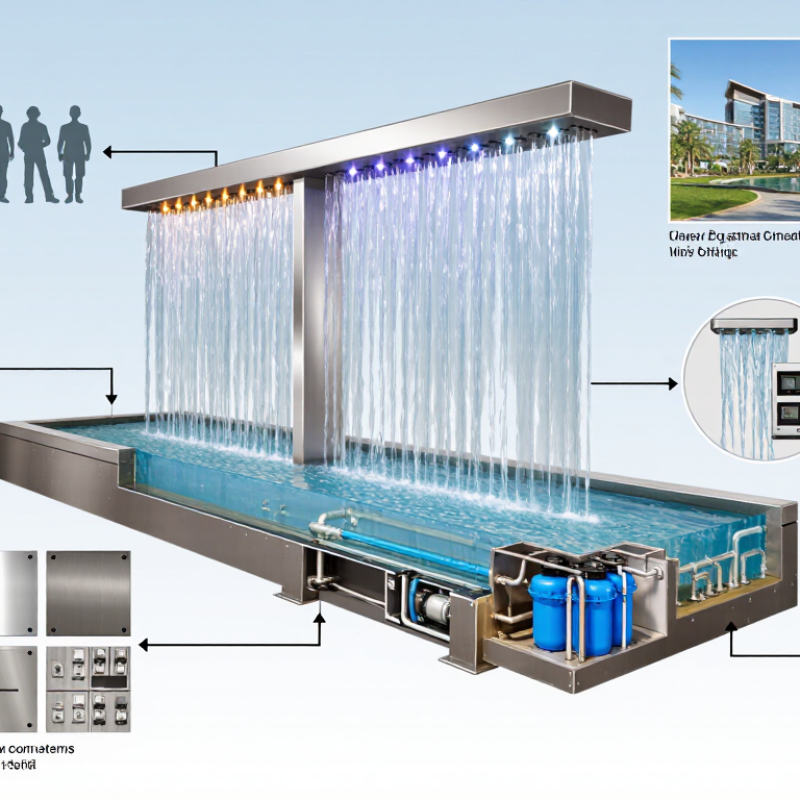
An outdoor water curtain fountain creates a vertical sheet of water from carefully arranged nozzles. Water falls in a smooth, transparent layer, almost like moving glass. Pumps send treated water through a manifold, while controllers regulate flow, height, lighting, and patterns. Some systems project images or text onto the falling surface. Others focus on simple movement and natural reflections.
In real installations, the fountain needs more than attractive design. Engineers must calculate pump pressure, nozzle spacing, wind exposure, drainage, and basin capacity. Even a light breeze can break the curtain into uneven streams. That detail matters. Stainless steel components can improve durability, but material quality alone cannot prevent poor installation. Filters, pumps, and nozzles require regular inspection. Hard water may also leave visible mineral marks.
A capable manufacturer should provide hydraulic calculations, structural drawings, control options, and clear maintenance guidance. Experience with outdoor projects helps teams adapt designs to plazas, gardens, hotels, and commercial entrances. Safety also depends on non-slip surfaces, protected electrical equipment, and suitable water treatment. A beautiful fountain can still perform badly when maintenance access is ignored. This is where planning often falls short. Manufacturers should test water flow before delivery and explain realistic operating limits. The best design is not always the largest one.
Outdoor water curtain fountains combine pumps, manifolds, nozzles, lighting, and digital controls. Unlike ordinary jets, they release water through many small outlets in a controlled line. A pump lifts recycled water from the basin and sends it through filters and pipes. The filter removes leaves, sand, and other debris. The water must stay clean.
At the top, a level header distributes water across each nozzle. Every nozzle shapes a thin stream, while gravity pulls it downward as a continuous curtain. Pressure must remain balanced across the header. If pressure changes, the curtain develops gaps or uneven thickness. During installation, technicians measure flow, pipe resistance, and nozzle spacing. Small adjustments often improve the visual result more than a larger pump. Wind remains a difficult factor.
Lighting controllers coordinate color changes with water movement. Some systems use programmable timing, sensors, and remote monitoring. Electrical components require suitable outdoor protection, grounding, and careful separation from wet areas. Drainage also matters, because splash water can damage nearby paving or electrical cabinets.
From practical installation experience, maintenance is rarely optional. Filters need inspection, nozzles need cleaning, and pumps require regular checks. A fountain may look perfect in design drawings but behave differently outdoors. That is where better judgment develops. Sunlight, wind, water quality, and visitor movement can all expose weaknesses. Reliable engineering leaves room for adjustment.
China’s leading fountain manufacturers combine practical engineering with careful project experience. They study the site before designing a water curtain system. Wind direction, sunlight, drainage, water quality, and visitor distance all affect performance. A reliable manufacturer should provide clear drawings, flow calculations, pump specifications, and maintenance access details.
Material selection matters outdoors. High-grade stainless steel can resist moisture, while protected electrical cabinets reduce corrosion risks. Precision nozzles help create an even water screen. Variable-speed pumps can control height and pressure. LED lighting should remain visible in daylight and avoid harsh glare at night. Smart control systems may coordinate water, light, music, and emergency shutdown functions. Small details matter.
Testing builds confidence. Experienced teams should inspect leakage, spray balance, electrical insulation, and control responses before shipment. They should also offer installation guidance, spare nozzle support, training, and written warranty terms. Ask for project photos, test records, and references from similar climates. Claims alone are not enough.
No supplier is perfect. Some designs look impressive but become difficult to clean. Others reduce initial costs with weaker components. That choice may create higher maintenance expenses later. A professional evaluation should compare lifecycle cost, not only the quotation. The strongest manufacturer is the one that communicates limitations clearly and adjusts the design when site conditions change.
Choosing the best Chinese water curtain fountain supplier requires more than comparing catalog prices. During project checks, I examine nozzle alignment, pump access, control cabinets, and drainage details. A supplier should provide hydraulic drawings, material specifications, factory test records, and installation guidance. Ask for stainless-steel grades, coating thickness, pump efficiency, and replacement-part availability. Vague answers create expensive problems later.
Water use and maintenance deserve equal attention. The UN World Water Development Report 2024 states that agriculture represents about 70% of global freshwater withdrawals. A fountain uses less water through recirculation, but evaporation, splash loss, and filtration still matter. Request a measured flow rate, tank volume, filtration plan, and projected monthly water loss. The U.S. Department of Energy also notes that inefficient pumping can create substantial energy waste, so suppliers should provide pump curves, motor ratings, and operating scenarios. Test the numbers.
Experience reveals small weaknesses. Ask for a video showing the curtain under wind conditions, not only a perfect indoor demonstration. Check whether lighting, sensors, and pumps are modular. Confirm remote support hours and warranty exclusions in writing. Industry reports can guide decisions, but they cannot replace a factory audit or a sample test. I would also request references for similar outdoor installations. One uncomfortable point remains: the cheapest quotation may hide thinner metal, weaker seals, or incomplete civil-work requirements. That risk deserves a line-by-line review.
| Evaluation Dimension | Recommended Weight | What to Check | Reliable Evidence | Practical Benchmark | Risk Level |
|---|---|---|---|---|---|
| Relevant Outdoor Experience | 15% | Experience with outdoor water curtain systems, fountain structures, pumps, lighting, controls, and site installation. | Project portfolio, technical drawings, commissioning records, and references for comparable installations. | Look for projects with similar climate, water volume, display size, and operating schedule rather than relying only on total years in business. | Medium |
| Hydraulic Performance | 20% | Water curtain height, width, uniformity, flow rate, pump head, nozzle arrangement, splash control, and filtration design. | Hydraulic calculations, pump curves, nozzle specifications, layout drawings, and a witnessed factory test where practical. | The supplier should provide calculated operating conditions; do not compare suppliers by pump power alone. | High |
| Material and Corrosion Resistance | 15% | Grade and finish of stainless steel, fasteners, pipes, cable protection, coatings, seals, and materials exposed to water or weather. | Material certificates, product datasheets, weld specifications, surface-treatment details, and inspection reports. | Material selection should match the project water chemistry, local climate, chlorides, humidity, and maintenance conditions. | High |
| Electrical and Control Safety | 15% | Control cabinet design, residual-current protection, grounding, cable routing, emergency stop, overload protection, and outdoor enclosure rating. | Single-line diagrams, control-panel drawings, electrical test records, compliance documentation, and installation instructions. | Electrical design must comply with the destination country’s regulations; an enclosure rating should be selected for the actual outdoor exposure. | High |
| Lighting and Media Integration | 10% | Underwater or splash-zone lighting, color control, brightness, synchronization, show-control compatibility, and replacement access. | Lighting datasheets, wiring diagrams, control protocol information, sample programs, and maintenance procedures. | Confirm whether lighting, audio, video, and fountain controls are supplied as one coordinated system or by separate parties. | Medium |
| Customization and Engineering Support | 10% | Ability to adapt the design to site dimensions, wind conditions, water source, drainage, power supply, local codes, and architectural requirements. | Preliminary design package, load calculations, interface schedule, 3D model or drawings, and a clearly defined scope of work. | A strong supplier identifies site constraints before quoting instead of offering a standard package without engineering review. | Medium |
| Quality Assurance and Factory Testing | 10% | Incoming-material inspection, welding quality, dimensional checks, pressure or leakage tests, electrical tests, and final functional testing. | Inspection and test plan, quality records, photos or videos, independent inspection option, and signed acceptance criteria. | Testing should be linked to measurable acceptance criteria, including flow uniformity, control functions, leakage, and safety interlocks. | High |
| Installation and Commissioning | 5% | Site supervision, installation drawings, startup procedures, operator training, balancing, programming, and handover documentation. | Method statement, installation schedule, commissioning checklist, training plan, and defined responsibility matrix. | Confirm in writing which works are included, such as civil works, electrical connections, pipework, testing, and local labor. | Medium |
| After-Sales Service and Spare Parts | 5% | Warranty terms, response process, remote support, spare-parts availability, troubleshooting documents, and long-term component support. | Written warranty, spare-parts list, service-level commitments, maintenance manual, and contact escalation procedure. | Evaluate total ownership cost, not only purchase price; pumps, lights, seals, filters, and control components require planned maintenance. | Medium |
| Commercial Transparency and Delivery | 5% | Clear quotation, inclusions and exclusions, production schedule, packaging, shipping responsibilities, payment terms, and change-order process. | Itemized quotation, contract scope, milestone schedule, packing specification, and documented communication process. | Compare equivalent scopes and technical specifications; the lowest initial quote may omit engineering, testing, installation, or spare parts. | Medium |
| Suggested Supplier-Selection Method | 100% | Score each supplier from 1 to 5 for every dimension, multiply by the recommended weight, and verify critical technical claims before contract award. | |||
Note: The weights and benchmarks above are a practical evaluation framework, not independent rankings or performance claims about any specific supplier. Final requirements should be confirmed against the project design, site conditions, local regulations, and contract specifications.
China Best Outdoor Water Curtain Fountain Manufacturer?
An outdoor water curtain needs more than attractive drawings. Designers should verify nozzle spacing, wind exposure, drainage, and viewing distance before fabrication. A 20-meter curtain may require different pump zoning than a 10-meter installation. Wind changes everything. The U.S. Department of Energy’s Pumping System Assessment Tool shows that inefficient pump operation can create substantial energy waste. Variable-speed drives, correctly selected impellers, and staged zones can reduce unnecessary pressure and splashing. However, oversized pumps remain common. Bigger is not always better.
Installation quality decides long-term reliability. The basin should include accessible filters, overflow protection, isolation valves, and safe electrical separation. Control cabinets need weather protection and clear maintenance access. The CDC’s Model Aquatic Health Code provides useful reference points for disinfectant management in public water features, although each project needs site-specific engineering. Water quality should be tested, not guessed. Operators should record pH, disinfectant levels, pump hours, and filter pressure.
Maintenance plans often look perfect on paper. Field conditions are less polite. EPA WaterSense reports that household leaks can waste more than 10,000 gallons annually, showing why small leaks deserve attention. For a large fountain, inspect seals, nozzles, lights, and grating weekly during operation. Clean filters before pressure rises sharply. Drain and winterize exposed pipework where freezing occurs. A practical manufacturer should provide drawings, spare-part lists, commissioning records, and operator training, not only a polished quotation.
Regular maintenance helps preserve water quality, nozzle performance, lighting, pumps, and control systems. The intervals shown are practical reference points for commercial outdoor installations; actual schedules should be adjusted according to climate, operating hours, water quality, and local regulations.
Survey wind direction, sunlight, drainage, water quality, and visitor distance. Wind changes everything. A 20-meter curtain may need different pump zones than a 10-meter system.
Moisture-resistant stainless steel helps reduce corrosion. Protected electrical cabinets add safety. Precision nozzles create a more even water screen, but no material remains maintenance-free.
Variable-speed pumps control water height and pressure more efficiently. Correct impellers and staged zones can reduce splashing. Bigger is not always better.
Lighting should remain visible in daylight without creating harsh glare at night. Smart controls can coordinate water, lighting, music, and emergency shutdowns.
Inspect leakage, spray balance, electrical insulation, and control responses. Request test records. Claims are not proof.
Include accessible filters, overflow protection, isolation valves, and separated electrical systems. Weatherproof control cabinets need clear maintenance access. Small details matter.
Test pH and disinfectant levels regularly. Record pump hours and filter pressure. Inspect seals, nozzles, lights, and grating weekly during operation.
Review drawings, flow calculations, pump specifications, spare-part lists, training, and warranty terms. Compare lifecycle costs, not only the quotation. A polished proposal can still hide weak components.
An Outdoor Water Curtain Fountain combines flowing water, programmable lighting, sound, and digital control to create a dynamic visual display for public spaces, hotels, commercial areas, and cultural venues. Its water screen is formed by carefully arranged nozzles that release a thin, even layer of water, allowing projected images, patterns, or color effects to appear across the surface. Pumps, filtration systems, lighting equipment, control software, and structural components work together to deliver stable and energy-efficient performance.
When selecting a Chinese water curtain fountain supplier, buyers should evaluate manufacturing experience, customization capabilities, technical support, product quality, and compliance with applicable safety standards. A reliable supplier should provide detailed design planning, professional installation guidance, testing, and long-term maintenance support. Important considerations include site dimensions, water quality, climate, power supply, drainage, operating costs, and repair access. Careful planning from design through maintenance helps ensure a safe, durable, visually impressive, and cost-effective fountain system.