
Commercial Filtration Systems
High-rate fiberglass and steel sand filters fitted with heavy-duty multiport valves and automatic backwash manifolds.

Eliminate human error, maintain DIN 19643 compliance, and optimise operational OPEX with precision digital chemical dosing skids engineered by Aura Fountains.
Written by Aura Fountains' Senior Technical Directors — Bringing 20+ Years of Hydraulic & Chemical Sanitation Expertise to Commercial Facility Operators, EPC Contractors, and Aquatic Consultants Worldwide.
In modern commercial swimming pool construction, water parks, municipal fountains, and industrial water treatment projects, water disinfection reliability is non-negotiable. Maintaining precise sanitiser residual levels is essential not only to satisfy stringent health standards (such as DIN 19643 and IS 3328) but also to safeguard public health against waterborne pathogens like Legionella pneumophila, Cryptosporidium, and Giardia lamblia.
Historically, commercial facilities relied on manual chlorine dosing or basic time-clock-driven chemical feeders. These legacy approaches consistently cause destructive chemical oscillations: dramatic spikes in free available chlorine (FAC) lead to eye irritation, hazardous chloramine off-gassing (nitrogen trichloride), aggressive equipment corrosion, and massive chemical waste. Conversely, sudden drops in chlorine level during peak bather loads leave the pool vulnerable to rapid algae blooms and bacterial proliferation.
The solution adopted by leading architectural engineers, hotel groups, and municipal utilities globally is the deployment of an Automatic Chlorine Dosing Pump integrated with real-time closed-loop micro-processor feedback. By continuously analyzing Oxidation-Reduction Potential (ORP / Redox) and pH parameters, automated chemical feed systems inject exact micro-doses of sodium hypochlorite (liquid chlorine) or calcium hypochlorite slurry directly into the recirculation filtration stream. This guide provides an exhaustive engineering analysis of automatic chlorine dosing pump technology, selection criteria, future industry trends, and practical troubleshooting insights for international B2B buyers.
To evaluate an automatic chlorine dosing pump, procurement directors must understand the chemical equilibrium of chlorine in aqueous solutions and how automated feedback loops operate.
When liquid sodium hypochlorite (NaOCl) is injected into water, it reacts dynamically with water molecules to form Hypochlorous Acid (HOCl) and Sodium Hydroxide (NaOH):
NaOCl + H₂O ⇌ HOCl + Na⁺ + OH⁻
Hypochlorous acid (HOCl) is the active, high-potency germicidal agent—up to 80 times more effective at killing bacteria than the hypochlorite ion (OCl⁻). However, the dissociation ratio between HOCl and OCl⁻ depends entirely on the water's pH value:
Therefore, a truly effective automatic chlorine dosing system must feature a dual-channel controller that simultaneously manages an automatic chlorine dosing pump and a pH correction pump (injecting dilute hydrochloric acid or sodium bisulfate). Without continuous pH stabilization, any chlorine dosing pump will fail to maintain microbiological safety.
Figure 1: Full hydraulic integration of high-flow sand filtration with an automated ORP/pH controlled chlorine dosing manifold engineered by Aura Fountains.
At Aura Fountains, we engineer and supply four primary classes of automatic chemical dosing pumps tailored to specific commercial flow rates, working pressures, and environmental constraints.
Best Suited For: Boutique hotel pools, luxury resort Jacuzzis, indoor hydrotherapy pools, and architectural water features with flow rates up to 50 m³/h.
Design Mechanics: Peristaltic pumps rely on heavy-duty motorized rollers rotating against a specialized flexible tube (Santoprene® or silicone) housed within a chemical-resistant rotor head. As the roller compresses the tube, it forces a metered volume of fluid forward while creating a powerful vacuum that draws chemical from the supply drum.
Key Advantages:
Best Suited For: High-capacity commercial swimming pools, splash parks, municipal fountains, and industrial effluent treatment plants operating against line backpressures up to 16 bar.
Design Mechanics: An electromagnetic solenoid coil drives a solid PTFE (Teflon) diaphragm back and forth inside a PVDF pump head. Suction and discharge stroke actions are controlled by double-ball ceramic check valves mounted in PVDF valve housings.
Key Advantages:
Best Suited For: Ultra-precise commercial projects requiring smooth, continuous dosing without severe pressure pulsation shock waves in plastic piping networks.
Design Mechanics: Driven by advanced micro-stepping motors, these pumps execute controlled suction and discharge strokes with fully configurable velocity profiles, preventing hydraulic hammer.
Best Suited For: EPC contractors, international resort developers, and government municipal aquatic centers seeking pre-plumbed, pre-wired "plug-and-play" water sanitation systems.
System Components: Dual diaphragm/peristaltic dosing pumps, pre-calibrated potentiometric ORP and pH sensors, acrylic bypass flow cell with rotameter, digital microprocessor controller with 4-20mA / Modbus outputs, low-level tank suction lances, and secondary containment chemical bund tanks.
The following engineering matrix outlines technical specifications to assist procurement teams in selecting the optimal automatic chlorine dosing pump configuration based on operational parameters:
| Parameter / Feature | Peristaltic Dosing Pump | Solenoid Diaphragm Pump | Stepper-Motor Drive Pump | Turnkey Dosing Skid |
|---|---|---|---|---|
| Flow Rate Range | 0.5 L/h – 10.0 L/h | 1.0 L/h – 100.0 L/h | 0.01 L/h – 150.0 L/h | Configurable (up to 500 L/h) |
| Max Operating Pressure | 1.5 bar – 3.0 bar | 5.0 bar – 16.0 bar | 10.0 bar – 16.0 bar | Up to 20.0 bar |
| Off-Gassing Handling | Self-priming / Immune | Requires Auto-Degassing Head | Integrated Air Bleed Valve | Integrated Auto-Vent Manifold |
| Pump Head Material | Polypropylene / Santoprene | PVDF / PTFE / Ceramic | PVDF / PTFE / SS 316L | PVDF / Industrial Grade PVC |
| Control Signal Options | ON/OFF, 4-20mA | Pulse Input, 4-20mA, RS485 | Proportional Pulse, Modbus RTU | Ethernet, Cloud IoT, Modbus TCP |
| Primary Commercial Use | Resorts, Spas, Fountains | Public Pools, Water Parks | Precision Industrial Treatment | Municipal & Large Commercial |
Our automatic chlorine dosing pumps integrate seamlessly into comprehensive commercial water filtration infrastructure built in-house at our manufacturing facility.
High-rate fiberglass and steel sand filters fitted with heavy-duty multiport valves and automatic backwash manifolds.

Custom-built micro-processor control panels driving chlorine pumps, UV sterilizers, and recirculation pump variable speed drives.

Precision-engineered hydraulic pumps and glass-clear laminar jets for commercial plazas, luxury pools, and water parks.

Energy-efficient, resin-filled SS 316 underwater lights producing 2,000+ RGB color combinations with low operational voltage.
As global environmental regulations tighten and operational automation becomes mandatory for commercial real estate developers, procurement trends for automatic chlorine dosing pumps are evolving rapidly. Technical buyers must consider these emerging developments during project design phase:
Modern commercial project specifications increasingly mandate cloud-connected dosing systems. Advanced automatic chlorine dosing pumps now feature onboard Wi-Fi / cellular modems transmitting data directly to cloud dashboards. Automated algorithms monitor sensor drift, alert engineers to low chemical drum levels before sanitation fails, and log compliance records automatically—eliminating physical logbooks for local health department audits.
Traditional systems estimated chlorine effectiveness solely via ORP electrodes. However, high cyanuric acid (stabilizer) concentrations or total dissolved solids (TDS) can distort ORP readings. The procurement trend is shifting toward potentiometric and amperometric Direct Free Chlorine probes. Multi-sensor data fusion controllers compare ORP, pH, temperature, conductivity, and free chlorine simultaneously to adjust dosing pump stroke length with unprecedented accuracy.
Over-chlorination generates harmful Trihalomethanes (THMs) and Haloacetic Acids (HAAs). Modern automatic dosing systems incorporate variable-speed stepless stroke technology. Instead of heavy chemical dumping cycles, pumps inject continuous, infinitesimal micro-doses. When combined with secondary UV-C sterilizers or commercial ozone generators, automatic chlorine dosing pumps operate at reduced baseline rates, dramatically enhancing indoor air and water quality.
For remote municipal fountains, eco-resorts, and off-grid water features, demand for 12V/24V DC brushless dosing pumps powered by dedicated solar-battery kits has surged. These pumps offer ultra-low power consumption without sacrificing high chemical injection pressure capability.
Choosing a chemical dosing pump supplier is not merely a purchase order transaction; it is a critical safety partnership. Sub-standard dosing pumps leak concentrated sodium hypochlorite, destroy electrical panels, burn out prematurely due to chemical crystallization, or cause severe health hazards due to inaccurate chemical feed.
Established in 2003 and headquartered in Noida, Delhi NCR, Aura Fountains (Aura Pools & Fountains) brings over two decades of technical authority, hands-on field experience, and certified manufacturing excellence to every installation.
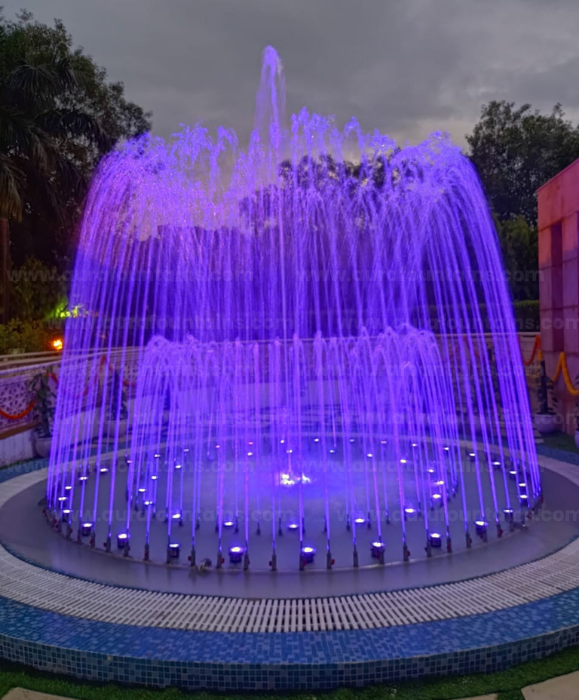
Our engineering team evaluates water turnover rates, pipe friction loss, chemical compatibility, and ambient temperature conditions to ensure your automatic chlorine dosing pump operates flawlessly for years.
These detailed answers address the most common technical questions asked by commercial procurement teams, MEP consultants, and facility managers when buying an automatic chlorine dosing pump:
The system operates via a continuous feedback control loop. An acrylic sample flow cell diverts a small stream of filtered pool water past platinum ORP (Oxidation-Reduction Potential) and glass pH electrodes. The digital chemical controller measures the millivolt (mV) signal from the ORP probe (indicative of sanitizing power) and the pH voltage. If the ORP falls below the target threshold (e.g., 720 mV), the controller energizes the automatic chlorine dosing pump relay or sends a 4-20mA variable speed signal. The pump injects concentrated liquid sodium hypochlorite until the setpoint is restored. Simultaneously, if pH rises above 7.4, the controller triggers a secondary acid dosing pump to maintain chemical balance.
Sodium hypochlorite naturally off-gasses chlorine gas, especially in high ambient temperatures or under suction vacuum. In standard mechanical diaphragm pumps, this gas forms an air pocket inside the pump chamber. Because gas is compressible, the diaphragm moves back and forth compressing the bubble without opening the check valves, resulting in loss of prime (vapor lock). Aura Fountains prevents this issue by utilizing self-venting PVDF pump heads with automatic degassing valves, or by deploying positive-displacement peristaltic dosing pumps that move gas and liquid through flexible Santoprene tubing without losing prime.
Pump sizing relies on pool volume (V in m³), turnover time (T in hours), peak bather load, and sunlight UV exposure. For standard outdoor commercial pools, an injection rating of 1.5 to 3.0 grams of pure available chlorine per m³ of water per hour is standard. For example, a 500 m³ commercial resort pool requiring 2.0 g/m³/h needs 1,000 grams (1 kg) of free chlorine per hour. If using a 10% sodium hypochlorite solution (100 grams active chlorine per liter), the required dosing pump output is calculated as: 1,000 g / 100 g/L = 10.0 Liters per hour (L/h). We recommend sizing the pump to operate at 50-70% of maximum stroke capacity to ensure long service life.
Sodium hypochlorite and calcium hypochlorite are highly corrosive oxidizing agents. Pump heads must be fabricated from inert materials. We mandate PVDF (Polyvinylidene Fluoride) or heavy-grade Polypropylene for pump bodies, PTFE (Teflon) for diaphragms, Ceramic or Pyrex for valve balls, and FPM/Viton® or EPDM for O-ring elastomer seals. Metallic components such as standard Stainless Steel (SS 304/316) should never come into contact with concentrated liquid chlorine solutions as rapid pitting corrosion will occur.
ON/OFF dosing pumps operate at 100% capacity until the setpoint is reached and then shut off completely. This simple method can cause minor chemical overshooting in small water bodies. Proportional dosing pumps receive a pulse signal from a water meter or a 4-20mA analog signal from a multi-parameter controller. As water parameters approach target setpoints, the pump automatically slows its stroke frequency down to micro-injection speeds. Proportional dosing delivers smoother chemical stabilization, prevents chemical waste, and extends pump diaphragm life.
To ensure 100% uptime, operators should perform monthly maintenance checks: (1) Clean and recalibrate ORP and pH sensors using buffer solutions (pH 4.0, pH 7.0, and 475 mV ORP standard); (2) Inspect foot valve suction strainers for chemical scale buildup; (3) Replace peristaltic squeeze tubing every 6 to 12 months; (4) Check ceramic ball valves in diaphragm pumps for signs of crystallization; (5) Flush pump heads with warm water during seasonal shutdowns to prevent calcium encrustation.
Yes. Aura Fountains routinely custom-engineers complete plug-and-play chemical dosing skids mounted on chemical-resistant, heavy-duty polypropylene backing panels. Skids are factory-tested, pre-wired for 110V/220V power supplies, packaged in export-grade wooden crates, and shipped with complete hydraulic schematics, installation manuals, and 12-month warranties for international developers and EPC contractors.
Investing in a high-grade Automatic Chlorine Dosing Pump is the single most effective action facility operators can take to ensure flawless water sanitation, protect expensive pool infrastructure, and deliver pristine water clarity. By eliminating manual handling, preventing chemical over-dosing, and operating with closed-loop precision, automated chemical feed systems pay for themselves through reduced chemical consumption and reduced maintenance labor within months of commissioning.
Whether you are designing a high-traffic commercial water park, retrofitting an existing hotel swimming pool, or specifying water treatment hardware for a municipal fountain project, Aura Fountains provides the engineering expertise, ISO 9001 certified manufacturing quality, and turnkey delivery support you require.